Pagalba
 Kontaktai
 Atsiliepimai
 Verslui
 Varlė
Varlė


Krepšelis tuščias
Turite Varlės paskyrą?
Prisijunkite, kad pamatytumėte krepšelio turinį
Prisijungti

 Visos prekės


 Krepšelis
Tuščias
Prekių
Krepšelis
Krepšelis
Tuščias
Prekių
Krepšelis
Prisijunkite, kad pamatytumėte krepšelio turinį
Prisijungti
 4.5
4.5

 4.5
4.5
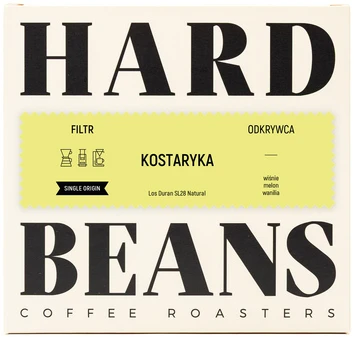
Origin: Costa Rica
Region: West Valley
Farm: Los Durán Micromill
Variety: SL28
Processing: Natural
Altitude: 1600 – 1900 m a.s.l.
ABOUT THE REGION AND FARM
Los Durán Micromill is located in Sarchí, in the West Valley region. Behind the project is Eduardo Durán along with his three sons: Barney, Kendall, and Arnold. The family has been growing coffee for years, but the next generation brought a new approach to work organization, technology, and processing to the farm. Barney is responsible for daily production and coffee processing. Kendall and Arnold, both software engineers by training, are involved in the development of the family business and its daily operation. The Duráns' farms are divided into several small lots. One of them is El Roble, where SL28 grows alongside Catuaí, Caturra, and new hybrids. A significant step in the farm's development was creating their own micromill right next to the family home. The project was led by Eduardo and Kendall. Thanks to this, the family took control of the stage that largely determines the character of the finished raw material: the selection, preparation, and drying of individual microlots. The micromill was equipped with raised beds and a greenhouse allowing for better control of drying conditions. It is a small scale of production, but a very conscious approach to every batch of coffee.
ABOUT THE VARIETY
SL28 is one of the varieties most strongly associated with Kenya and East African coffees. It is valued primarily for its high quality potential and distinct sensory profile. At Los Durán, it grows on the El Roble lot, in a completely different environment from the one we usually connect it with. This exact combination is particularly interesting here: Kenyan genetics interpreted by the terroir of the Costa Rican West Valley.
ABOUT THE PROCESSING
In the case of this lot, the natural process was applied, where whole fruits remain around the beans throughout the entire drying period. Ripe cherries are selectively harvested and sorted, and then placed on raised beds. The fruits are spread in a controlled layer and turned regularly to reduce differences in the rate of moisture loss. Drying takes about 21 days, depending on weather conditions. Throughout this time, the skin and pulp remain around the beans. After reaching the appropriate moisture content, the coffee is left to rest, and only later undergoes dry milling and preparation for export. In this method, fruit selection and the drying process itself become particularly important. Too fast or uneven moisture loss can negatively affect the quality of the lot. Having their own micromill allows the Durán family to carry out this stage directly on site and adjust it to the conditions of each lot.
RECIPE
Method: Pour water over the coffee in 5 equal pours (e.g., 5x 60 g) at 30-second intervals.
The water between pours should completely drain through the coffee.
If the water flows too slowly or too fast, change the grind size to coarser/finer.
Remember to use soft, filtered water!
Store in a cool and dry place.


 2-5 d. d.

 2-5 d. d.
 2-5 d. d.
 2-5 d. d.
 2-5 d. d.
 2-4 d. d.
 2-4 d. d.

 4-7 d. d.


 5.0
2-4 d. d.
5.0
2-4 d. d.

 7-10 d. d.
 2-3 d. d.

 4-6 d. d.

 5.0
1-3 d. d.
5.0
1-3 d. d.
 7-9 d. d.

 5.0
1-2 d. d.
5.0
1-2 d. d.


 LP EXPRESS paštomate spalio 9 d.
 Omniva paštomate spalio 9 d.
 Pristatymas Venipak kurjeriu spalio 9 d.
 DPD kurjeriu spalio 9 d.