Pagalba
 Kontaktai
 Atsiliepimai
 Verslui
 Varlė


Krepšelis tuščias
Turite Varlės paskyrą?
Prisijunkite, kad pamatytumėte krepšelio turinį
Prisijungti

 Visos prekės


 Krepšelis
Tuščias
Prekių
Krepšelis
Prisijunkite, kad pamatytumėte krepšelio turinį
Prisijungti
 4.6

 4.6
Ši prekė

 KNYGA Margo Jefferson On Michael Jackson
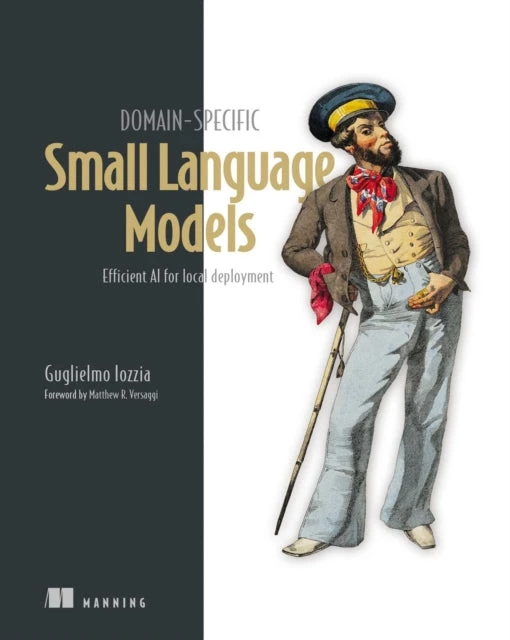
Get the eBook free when you register your print book at Manning.When you need a language model to respond accurately and quickly about a specific field of knowledge, the sprawling capacity of a LLM may hurt more than it helps. This book teaches you to build generative AI models optimized for specific fields.Perfect for cost- or hardware-constrained environments, Small Language Models (SLMs) train on domain specific data for high-quality results in specific tasks. In this book you’ll develop SLMs that can generate everything from Python code to protein structures and antibody sequences—all on commodity hardware.In Domain-Specific Small Language Models you’ll discover:• Model sizing best practices• Open source libraries, frameworks, utilities and runtimes• Fine-tuning techniques for custom datasets• Hugging Face’s libraries for SLMs• Running SLMs on commodity hardware• Model optimization or quantizationForeword by Matthew R. Versaggi.About the technologySmall-footprint language models trained on custom data sets and hosted locally can perform as well as large generalist models in speed and accuracy, often at a fraction of the cost. Domain-Specific Small Language Models shows you how to build privacy-preserving and regulation-compliant SLMs for agentic systems, specialist applications, and deployment on the edge.About the bookThis is a practical book that shows you how to adapt pretrained open source models to your domain using transfer learning and parameter-efficient fine-tuning. You’ll learn to minimize cost through optimization and quantization, develop secure APIs to serve your models, and deploy SLMs on commodity hardware—including small devices. The hands-on examples include integrating SLMs into RAG systems and agentic workflows.What's inside• ONNX and other quantization methods• Integrate SLMs into end-to-end applications• Deploy SLMs on laptops, smartphones, and other devicesAbout the readerFor AI engineers familiar with Python.About the authorGuglielmo Iozzia is a Director of AI and Applied Mathematics at Merck & Co. and a Distinguished Member of the American Society for Artificial Intelligence. He specializes in AI biomedical applications.The technical editor on this book was Riccardo Mattivi.Table of ContentsPart 11 Small language modelsPart 22 Tuning for a specific domain3 End-to-end transformer fine-tuning4 Running inference5 Exploring ONNX6 Quantizing for your production environmentPart 37 Generating Python code8 Generating protein structuresPart 49 Advanced quantization techniques10 Profiling insights11 Deployment and serving12 Running on your laptop13 Creating end-to-end LLM applications14 Advanced components for LLM applications15 Test-time compute and small language models

 5-10 d. d.
 5-10 d. d.
 5-10 d. d.

 3-5 d. d.

 45 d. d.

 2-2 d. d.

 2-3 d. d.


 Atsiėmimas Venipak paštomate lapkričio 30 d.