 Pagalba
 Kontaktai
 Atsiliepimai
 Verslui
 Varlė


Krepšelis tuščias
Turite Varlės paskyrą?
Prisijunkite, kad pamatytumėte krepšelio turinį
Prisijungti

 Visos prekės


 Krepšelis
Tuščias
Prekių
Krepšelis
Prisijunkite, kad pamatytumėte krepšelio turinį
Prisijungti
 4.6

 4.6
Ši prekė

 KNYGA Margo Jefferson On Michael Jackson
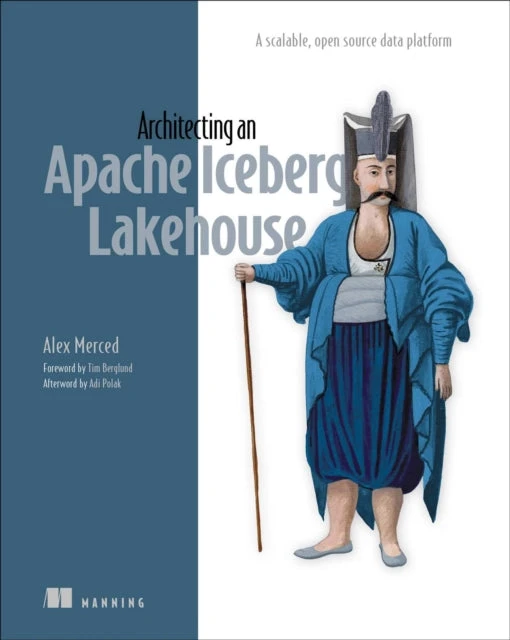
Get the eBook free when you register your print book at Manning.Design an Apache Iceberg lakehouse from scratch!The “lakehouse” data architecture is a powerful way to combine the flexibility of data lakes with the management features of data warehouses. The open source Apache Iceberg framework delivers the scalability, reliability, and performance you want from a lakehouse without the expense and vendor lock-in of platforms like Snowflake, BigQuery, and Redshift.In Architecting an Apache Iceberg Data Lakehouse, data guru Alex Merced shows you:• How to create a modular, scalable Iceberg lakehouse architecture• Where Spark, Flink, Dremio, Polaris fit into your design• Reliable batch and streaming ingestion pipelines• Strategies for governance, security, and performance at scaleApache Iceberg is an open source table format perfect for massive analytic datasets. Iceberg enables ACID transactions, schema evolution, and high-performance queries on data lakes using multiple compute engines like Spark, Trino, Flink, Presto, and Hive. An Iceberg data lakehouse enables fast, reliable analytics at scale while retaining the observability you need for compliance audits, governance, and provable data security.Foreword by Tim Berglund. Afterword by Adi Polak.About the technologyApache Iceberg is an open data format that lets data lake files work like database tables. It helps turn a data lake into a more reliable and capable lakehouse.About the bookArchitecting an Apache Iceberg Lakehouse shows you how to design an open, scalable, and cost-effective lakehouse platform with Apache Iceberg. More than a set of blueprints, the book explains the reasoning behind the architecture. You’ll build a mini lakehouse by ingesting sales and marketing data from PostgreSQL into Iceberg tables with Apache Spark and then create interactive dashboards in Apache Superset. You’ll appreciate expert Alex Merced’s real-world insights about operating an Iceberg lakehouse.What's inside• Create a modular, scalable Iceberg lakehouse architecture• Fit Spark, Flink, Dremio, Polaris and more into your design• Batch and streaming ingestion pipelines• Governance, security, and performance at scaleAbout the readerFor data architects familiar with the basics of a data lakehouse.About the authorAlex Merced is Head of Developer Relations at Dremio. He shares his expertise through videos, podcasts, and articles, and leads the DataLakehouseHub.com community.Table of ContentsPart 11 The world of the data lakehouse2 Apache Iceberg and the lakehouse3 Hands-on with Apache IcebergPart 24 Preparing for your move to Apache Iceberg5 Selecting the storage layer6 Architecting the ingestion layer7 Implementing the catalog layer8 Designing the federation layer9 Understanding the consumption layerPart 3 Operating your Apache Iceberg lakehouse10 Maintaining an Iceberg lakehouse11 Operationalizing Apache IcebergA The metadata tablesB Python for Apache IcebergC The Apache Iceberg specification

 5-10 d. d.
 5-10 d. d.
 5-10 d. d.
 5-10 d. d.
 5-10 d. d.
 5-10 d. d.


 5.0
3-6 d. d.

 4-6 d. d.

 65 d. d.

 2-5 d. d.

 4-7 d. d.

 5.0
5-6 d. d.

 5.0
5-6 d. d.


 gruodžio 4 d.


