Pagalba
 Kontaktai
 Atsiliepimai
 Verslui
 Varlė
Varlė


Krepšelis tuščias
Turite Varlės paskyrą?
Prisijunkite, kad pamatytumėte krepšelio turinį
Prisijungti

 Visos prekės


 Krepšelis
Tuščias
Prekių
Krepšelis
Krepšelis
Tuščias
Prekių
Krepšelis
Prisijunkite, kad pamatytumėte krepšelio turinį
Prisijungti
 4.5
4.5

 4.5
4.5


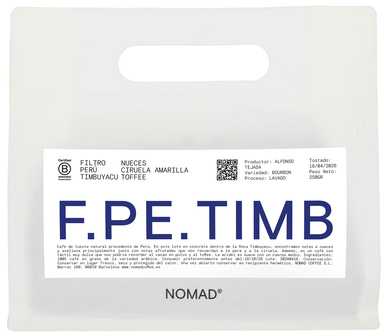
Country: Peru
Processing: Washed
Altitude : 1620 m a.s.l.
Varietal : Colasay Bourbon
ABOUT THE COFFEE
At NOMAD looking to establish a new long-term relationship for our house coffee section. Sofie from Sucafina recommended that we contact Alfonso from Café Monteverde and his Timuyacu farm, as his philosophy and values in the pursuit of quality, caring for his people, and protecting the environment aligned with NOMAD values. Alfonso sent us samples of several of his lots, including this Washed Bourbon from Colasay Washed was a perfect fit for what we were looking for. A sweet, easy-drinking coffee, slightly fruity but not overly so, ideal for one of our house coffees.
ABOUT THE FARM
Timbuyacu comes from the Quechua words Timbu (boiling) and Yacu (water), referring to a natural water spring located within the farm, where the water bubbled up as if it were boiling. This farm has a long family history, from Alfonso's grandmother, Eleodora Mori de Ibérico, to the present day, where Alfonso is in charge of the care, sale, and export of the coffee. The farm is divided into several plots: Vista Hermosa, El Mirador, Pirruro, Nuevo México, Alto Timbuyacu, Jergón, El Shapingo, El Pante, La Cabaña, Quishtucto, Pileta, and Las Peñas. This particular lot comes from the El Pante plot, named for the predominant presence of native Pante trees distributed throughout it.
The farm works with a regenerative approach, recovering degraded soils through the use of organic matter, agroforestry systems, and comprehensive management from germination to post-harvest. This is something we greatly value at NOMAD.
In short, we are grateful to have met and started this relationship with Timbuyacu and hope to have their coffees from now on. This commercial relationship has been directly facilitated by Sucafina's help in importing and financing the lot.
ABOUT THE PROCESS
The coffee is selectively hand-picked and pulped in a drum pulper. After pulping, it is fermented for 18 to 24 hours and washed with clean water. The resulting parchment is placed on drying beds or patios where it is regularly turned to ensure even drying.
The drying process takes approximately 15 to 20 days. Once dry and at the required moisture level, the parchment is stored on the farm for approximately 60 days before being transported to the dry mill for threshing and export.
Store in a cold and dry space.
 2-5 d. d.
 4-5 d. d.
 2-4 d. d.
 2-4 d. d.
 2-4 d. d.
 2-4 d. d.
 2-4 d. d.
 10 d. d.
 5-8 d. d.
 5-7 d. d.
 7-10 d. d.

 2-4 d. d.

 1-3 d. d.

 1-4 d. d.


 LP Express paštomate liepos 17 d.
 Omniva paštomate liepos 17 d.
 DPD paštomate liepos 17 d.
 Venipak paštomate liepos 17 d.
 SmartPosti paštomate liepos 17 d.